Thesis
The uncompiled institution
Institutions are state machines implemented in text. That substrate guarantees drift. The firm must be compiled.
May 2, 2026 · Luca Eich
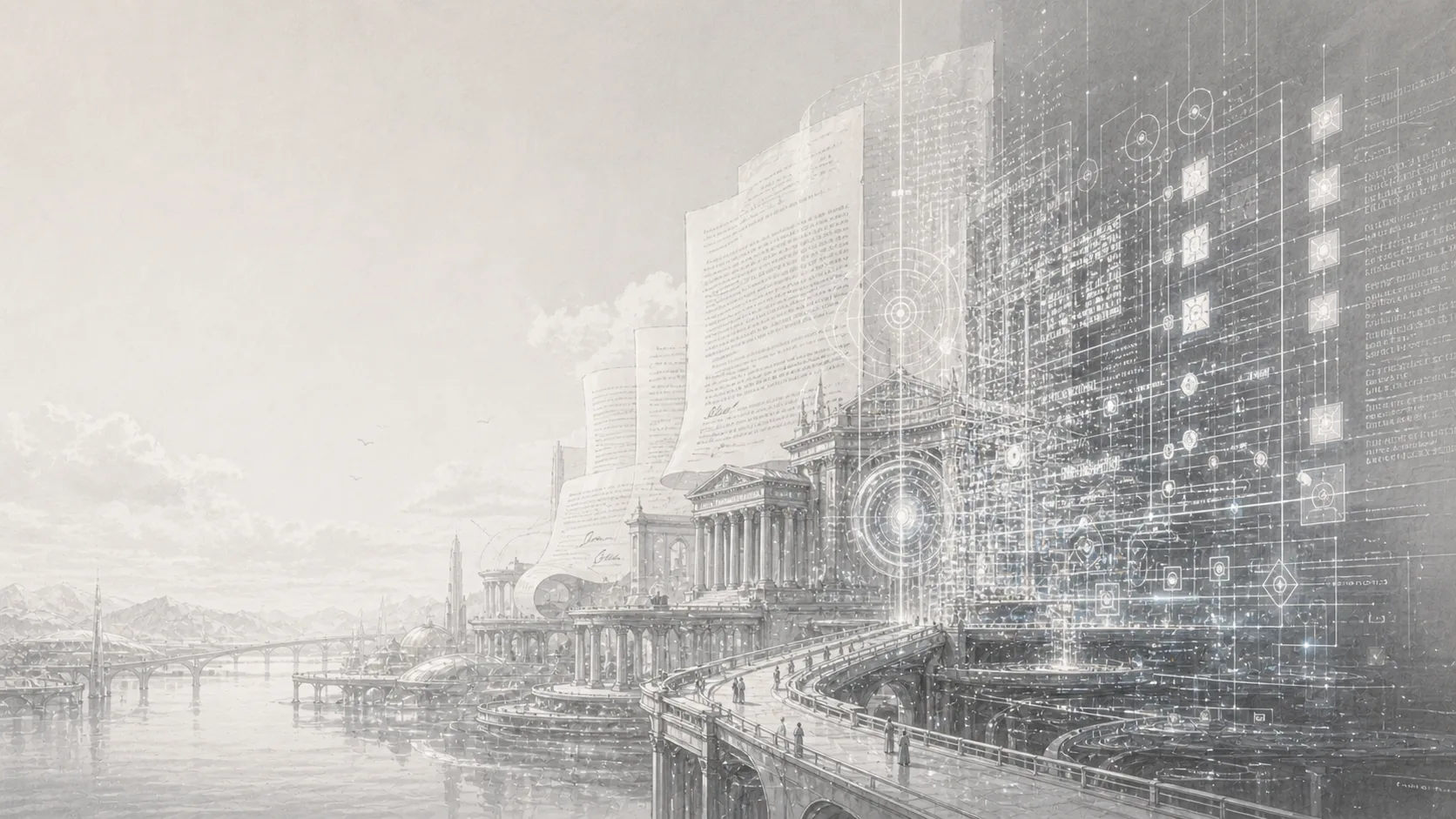
An institution is not a building. It is not a document. It is a state machine.
It coordinates partners, roles, budgets, vesting, and ownership. These surfaces define authority, value flow, and valid transitions. They follow logic. They behave like computation.
Today, however, that computation runs on text.
Cap tables live in spreadsheets. Vesting is updated manually. Board decisions live in PDFs. Rights are defined in agreements that require human interpretation to execute.
Modern SaaS tools automate fragments of this lifecycle, but none are authoritative. Each system maintains its own local model of state, and all of them must reconcile back to the wet-ink documents.
The physics of Drift
Inevitably, these systems Drift.
Different parties hold different versions of reality. SAFE conversions lag. Pools diverge from intended allocations. Governance rights become inconsistent.
These are not operational mistakes. They are the thermodynamic consequence of a substrate defined by text and maintained by humans. Text guarantees ambiguity. Ambiguity guarantees drift.
This substrate made sense when transaction costs were high — when communication was slow, coordination was local, and verification was expensive. The corporate form evolved around those limitations: negotiation, precedent, exceptions, and intermediaries.
Those limitations no longer exist.
The verification flip
State can now be verified cryptographically. Authority can be expressed formally. Execution can be deterministic.
A document-based institution cannot operate at this speed. When the velocity of capital exceeds the velocity of legal reconciliation, the firm breaks. The problem is not workflow inefficiency; it is a fundamental mismatch between the medium (paper) and the operating tempo (digital).
Artificial intelligence makes this gap terminal.
An AI agent cannot operate a structure defined by ambiguity, discretionary interpretation, or delayed reconciliation. A machine can execute deterministic rules, but it cannot infer intent from a PDF. For AI to participate in the economy as a sovereign actor, the institution must be readable by machines.
The compiler
Systems built on compiled institutions gain structural advantages that are impossible in the legacy world: real-time NAV computation, deterministic carry routing, continuous governance, instant liquidity, automated role management.
Uncompiled institutions (legacy):
- Canonical state lives in documents.
- Authority is established socially.
- Execution depends on interpretation.
- Result: entropy increases over time.
Compiled institutions (aeiq):
- State is canonical and machine-verifiable.
- Authority is defined in a formal grammar.
- Execution follows deterministic rules.
- Result: entropy is structurally constrained.
The legacy corporate substrate cannot be compiled. It was not designed as a computational system. It grew through legal precedent and administrative practice, not specification. Automation can surround it, but it cannot repair the substrate itself.
aeiq provides the compiler.
Entities are not filed; they are instantiated.
Ownership is not recorded; it is balanced.
Rights are not promised; they are enforced.
This is not software that assists an institution. It is the institution, represented as computation.
For where the compiled institution sits across the rest of the company-formation space — DAOs, hybrid wrappers, token instruments, and the platforms shipping today — see The landscape.
Start something that can work without you.